

The most impactful Certified Scrum Product Ownership (CSPO), product thinking, and product management workshop you can attend.
Online: Four (4) 3.5-hour hands-on days
In Person: Two (2) 8-hour hands-on days
If you need to understand how product thinking and a product operating model improves you, your job, and your business, this is the workshop for you. Yes, this is a Certified Scrum Product Ownership class, so you will get your Scrum Alliance certification. But, more importantly, you’ll really understand the mindset and process changes you’ll need to succeed. And you’ll have lots of fun doing it.
You’ll learn how focusing on the people who use your products makes your job more satisfying and lets your business see how ROI takes care of itself.
This workshop is led by Jeff Patton, author of User Story Mapping, and long time product leadership coach.

In the words of Marty Cagan, author of the leading product books Inspired, Empowered, and Transformed:
“I have long encouraged people to get their CSPO training from Jeff Patton because I know he knows the difference [between the Scrum product owner role and genuine product management].”
- Marty Cagan, more here: https://www.svpg.com/the-cspo-pathology/

In the words of Joakim Sunden product model transformation expert, co-creator of the Spotify model, and author of Kanban in Action:
“I genuinely believe Jeff’s thinking and teaching helped set Spotify on a strong trajectory as we continued to shape and refine what later became known as the Spotify Model. His work didn’t just influence how teams worked – it influenced how we thought about product, customers, and responsibility.”
- Joakim Sunden, https://betterproductwork.com/
9 Critical things you’ll learn and the big payoff:
1. Product thinking essentials
Understanding and separating important concepts such as business needs, product opportunities, output, outcome, and business impact.
2. Product Operating Model
A clear definition of a product operating model (POM) and a way to evaluate and improve your organization’s POM. Why it’s increasingly important to both use and speed up your continuous product improvement to work with 21st century products that don’t just release once, but must continuously improve to survive.
3. Organizing your Product Hierarchy
Identifying all the nested and dependent products in your organization and organizing effective product teams around them. Understand the difference between your end products, customer enabling products, employee enabling products, product team enabling products, and partner enabling products.
4. Focus and Prioritization
How to use your organization’s mission, vision, and strategy to focus on the right opportunities. How to use Objectives and Key Results (OKR) to clearly communicate your intention and measure success. How to prioritize what features go into the next release, and what stories go into the next sprint.
5. Stories and Story Mapping
How stories and story telling are really used to improve team communication and keep the whole team focused on product success throughout your whole process. How to use story mapping to decompose new feature ideas, or large stories, into small manageable parts.
6. Product Discovery
How to identify and test risks in your product ideas using a variety of different types of experiments.
7. Dual-Track Development
How to involve the whole team in discovery work while keeping delivery work moving strong. How real product teams work effectively in Scrum and other Agile approaches.
8. Release Strategies
How to find effective release strategies that focus on smaller successful releases that maximize value and minimize risk. How to separate releases to earn from releases to learn.
9. Product Leadership Roles and Responsibilities
How to decide the real responsibilities for the product leadership roles your organization might have such as product owner, product manager, group product manager, or head of product. How those responsibilities change depending on the type of product you’re working on, and the kind of team you’re working with.
The big payoff
While what you’ve just read is an ambitious list of concepts and lots of practices that support them, the really big payoff for you as an attendee is deeply understanding and caring about the work you do. The really big payoff for your organization is really understanding how to use product thinking to delight your users, your employees, and see the ROI take care of itself. Everyone wins.
Who should attend:
I’ve been told by very reliable sources that, although this class covers what you need to know to be an effective product owner or manager, it’s not just for those people. It’s what every team member and leadership should understand to work well in contemporary technology development.
- Product Owners and Product Managers
- Scrum Masters, Agile Coaches, and Consultants
- UX People, Researchers, and Designers
- Business Analysts and Subject Matter Experts
- Senior Engineers
- Transformation Leaders
- Product and Organizational Leadership
The unique way this course is instructed.
You won’t be watching PowerPoint slides.
Here you’ll find Jeff Patton’s unique way of teaching and leading discussions where he draws pictures as he speaks. I suspect you’ve all seen cool videos of a talk illustrated as the speaker speaks. Now imagine your instructor creating unique models that directly illustrate the difficult concepts being discussed. It’s a lot less boring and you’ll end up with a stronger understanding of what you’ve learned.
Here’s a good example of what this looks like:
And you need only go to YouTube and search for Jeff Patton talks to see lots more examples!
You’ll be collaborating with others a lot:
If we were working together face to face you’d all have a Sharpie marker, lots of sticky notes, and be sitting at a big table with 3 or 4 others where you all can visualize your thinking.
But, in a post-pandemic world we’re often working online. In this workshop you’ll work with your small product team together in a Zoom breakout room. Instead of using Sharpie markers and sticky notes, you’ll be using the tool Mural to create visualizations together. It looks a bit like this:
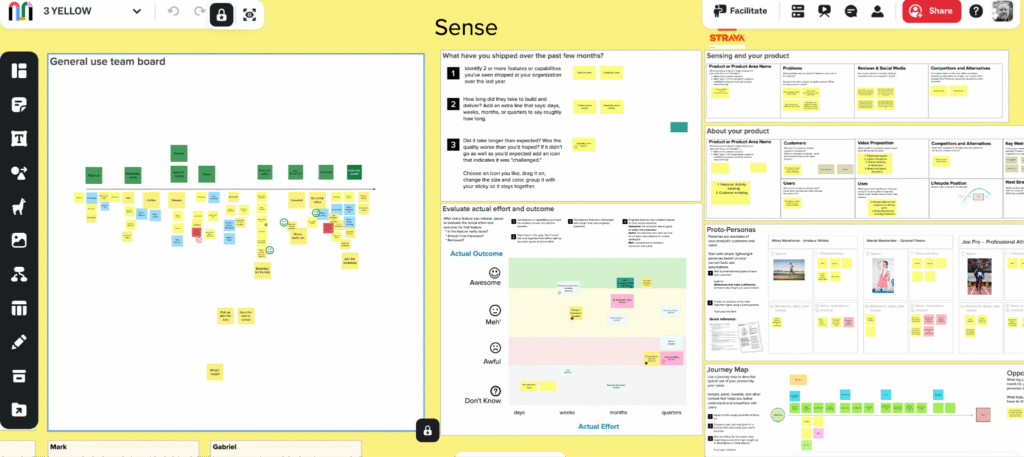
That’s a bit of a busy team board created in Mural in a recent workshop.
More about Jeff Patton, your instructor:

Jeff makes use of over 25 years of product design and development experience to help companies create great products.
Jeff started in software development in the early 90s as a project leader and senior developer for a small software product company. There he learned that well written code, and fast delivery isn’t the secret to success, it’s just table stakes. It’s actually a deep understanding of your customers and users coupled with a desire to create a product that’s really valuable to them that makes the biggest difference.
Today, Jeff Patton helps companies adopt a way of working that’s focused on building great products, not just building stuff faster. Jeff blends a mixture of Agile thinking, Lean and Lean Startup Thinking, and UX Design and Design Thinking to end up with a holistic product-centric way of working. He authored the bestselling O’Reilly book, User Story Mapping, which describes a simple holistic approach to using stories in Agile development without losing sight of the big picture. You can learn more about Jeff at: jpattonassociates.com.
The course day-by-day:
The course will be taught over 4 days in 3-hour sessions followed by a half hour open Q&A.
It’s not too exhausting. We’ll take a 10-minute break every hour and you’ll spend a lot of your time collaborating with others.
The class is structured around a few days in the life of an effective product owner/manager. You’ll learn by doing the actual work of a product owner and product team, and reflect every day on how you can do this where you work.
Session 1: Product Model and Team Fundamentals
- Product Thinking Essentials: Business needs, opportunities, output, outcome, and impact
- Map your actual outcome & impact and identify next steps based on actual outcomes
- MVP: minimum viable products, why they’re both critical and confusing
- Continuous Product Improvement sense, focus, discover, and deliver
- Product team essentials
- Finding opportunities using product Interviews
- Reteam around products you’d like to work on and build backlogs for them
Session 2: Focusing On Problems to Solve
- Agile stories and how they’re used
- Focus: Mission, vision, and strategy
- Understand your product’s mission, vision, and strategy and reorganize backlogs based on where your organization focuses
- Product metrics
- Business problem and business OKRs
- Identifying a target user and reorganize your backlog based on that target
- Creating simple proto-personas for target users
Session 3: Identify and de-risk solutions
- Writing a Product OKR focused on your target users
- Identify best solutions and prioritize them
- Identify options in your best solution
- Understanding product discovery essentials
- Identify your next best test and your discovery approach with your product solution
Session 4: Build and release your solutions
- Envision your solution
- Using story maps to decompose your solution
- Create a successful release strategy
- Understand your development strategy
- Using routine backlog refinement to work with your team
- Tying it all together in dual-track development
- Reflection: what can you do next?