

Learn the skill that helps all product team members work with Agile user stories confidently and become truly effective in their role.
Online: Two (2) 3.5-hour hands-on days
In Person: One (1) 8-hour hands-on day
20 years ago story mapping was a clever idea to work with agile user stories. Today it’s both a best practice and a genuine necessity for product owners, managers, UX people, and all product team members to:
- Understand their users and the way they work today
- Envision and build shared understanding for a solution to be built
- Break a big story down into smaller buildable parts
- Consider many alternative options
- Prioritize and develop a release strategy that maximizes value and minimizes risk
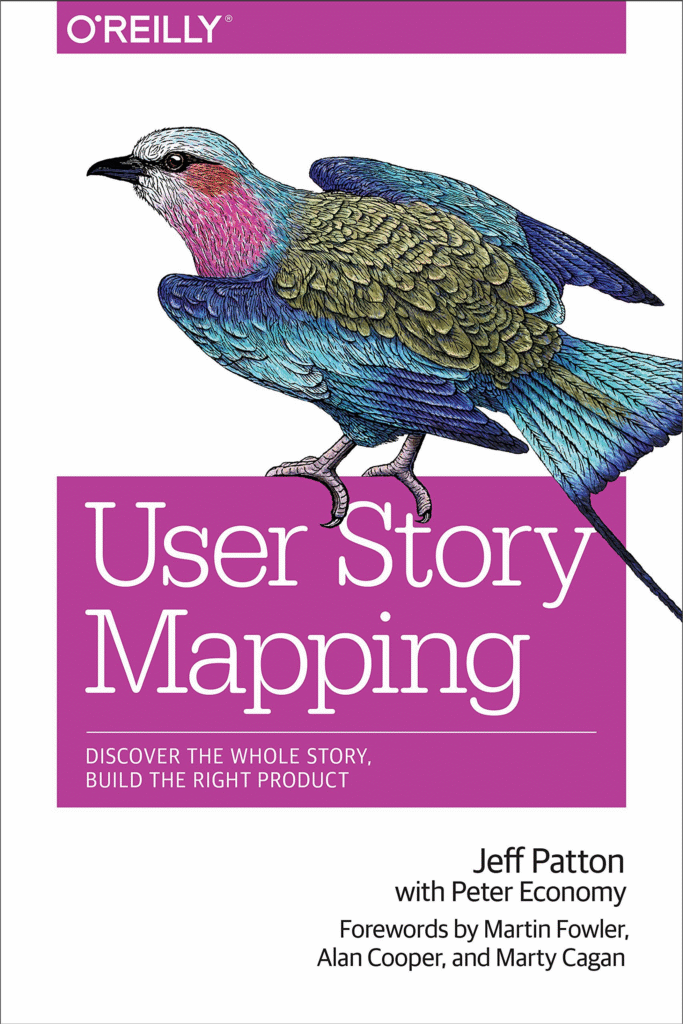
You’ll learn Story Mapping from Jeff Patton, the creator and best selling author of User Story Mapping. No one will be able to tell you that you don’t get it after your experience!
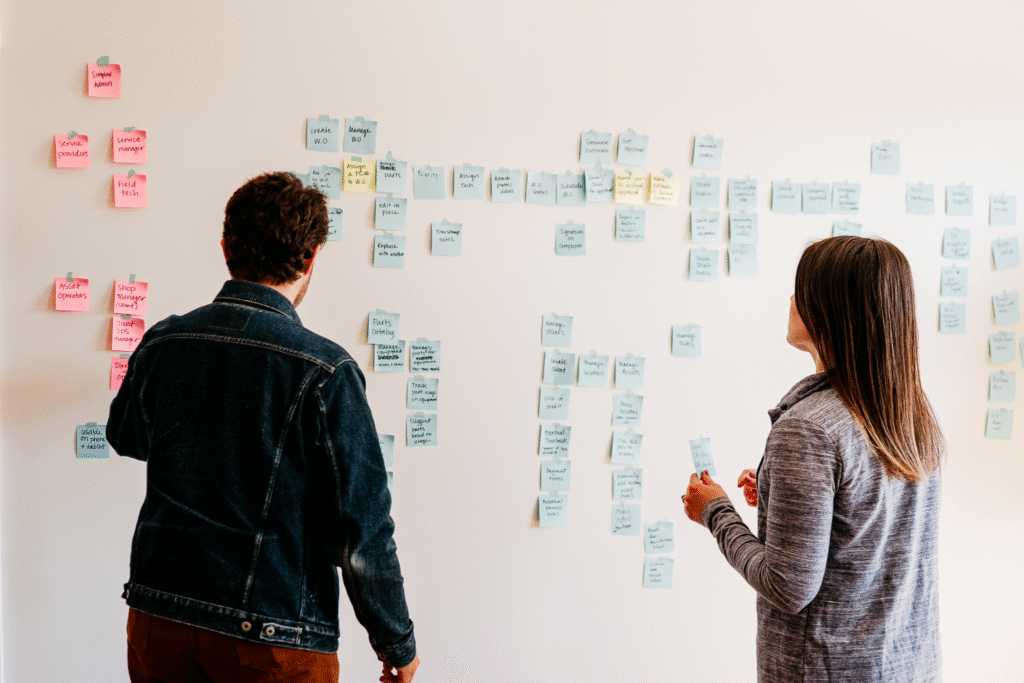
Story Mapping is a simple collaborative practice that helps you break down and visualize your big ideas by simply telling them as stories.
Learning to story map will help you up your game when working with Agile Stories. And even if you don’t use agile development, understanding how to visualize customer behavior, business process, or even your own behavior will help you understand and really solve tough problems.
Photo courtesy of Bill Barnett
The unique way this course is instructed:
You won’t be watching PowerPoint slides.
Here you’ll find Jeff Patton has a unique way of teaching and leading discussions by drawing pictures as he speaks. I suspect you’ve all seen cool videos of a talk illustrated as the speaker speaks. Now imagine your instructor creating unique models that directly illustrate the difficult concepts being discussed. It’s a lot less boring and you’ll end up with a stronger understanding of what you’ve learned.
Here’s a good example of what this looks like:
And you need only go to YouTube and search for Jeff Patton talks to see lots more examples!
You’ll be collaborating with others a lot
If we were working together face to face you’d all have a Sharpie marker, lots of sticky notes, and be sitting at a big table with 3 or 4 others where you all can visualize your thinking.
But, in a post-pandemic world we’re likely to be working online. You’ll work with your small product team together in a Zoom breakout room. Instead of using Sharpie markers and sticky notes, you’ll be using the tool Mural to create visualizations together. It looks a bit like this:
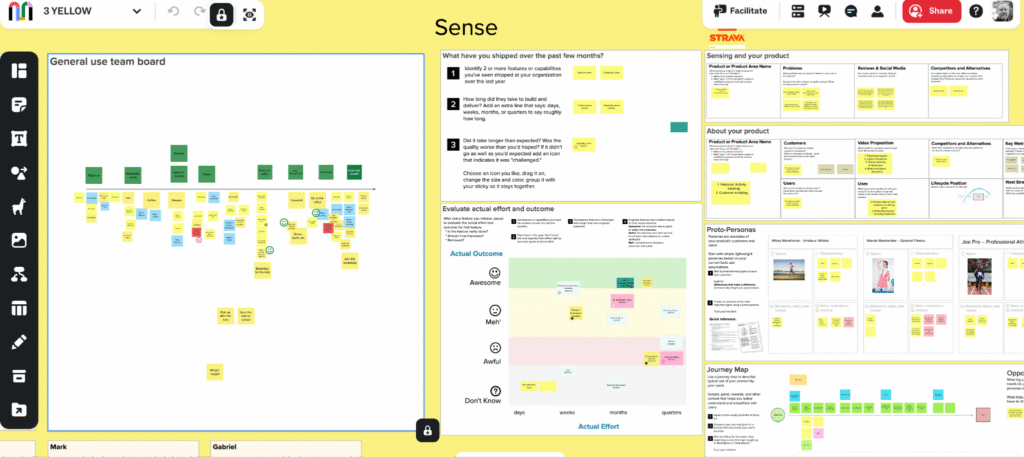
That’s a bit of a busy team board created in Mural in a recent workshop.
More about Jeff Patton, your instructor:
Jeff makes use of over 25 years of product design and development experience to help companies create great products.
Jeff started in software development in the early 90s as a project leader and senior developer for a small software product company. There he learned that well written code, and fast delivery isn’t the secret to success, it’s just table stakes. It’s actually a deep understanding of your customers and users coupled with a desire to create a product that’s really valuable to them that makes the biggest difference.
Today, Jeff Patton helps companies adopt a way of working that’s focused on building great products, not just building stuff faster. Jeff blends a mixture of Agile thinking, Lean and Lean Startup Thinking, and UX Design and Design Thinking to end up with a holistic product-centric way of working. He authored the bestselling O’Reilly book, User Story Mapping, which describes a simple holistic approach to using stories in Agile development without losing sight of the big picture. You can learn more about Jeff at: jpattonassociates.com.
The course day-by-day:
The course will be taught over 2 days in 3-hour sessions followed by a half hour open Q&A.
It’s not too exhausting. We’ll take a 10-minute break every hour and you’ll spend a lot of your time collaborating with others.
The class will be structured around really finding user stories, breaking them down, and then effectively prioritizing the details into successful release strategies and day-to-day development. You’ll learn how to work together with your whole team to really own, or PWN, stories.
Session 1: Understanding and Using Stories
- The purpose of agile stories
- Conversations that help you write stories
- Understanding big stories with an epic canvas
- Mapping to break down big stories
Session 2: Breaking down, Prioritizing, and Managing Development
- Envisioning your solution
- Creating a release strategy
- Identifying a release to learn
- Creating a development strategy
- Working with your team every day to build working software